
Liquid helium is one of the most valuable cryogenic fluids utilized in high technology medical, scientific, research and industrial applications. It has a very low boiling point and has special cryogenic properties which are vital for the cooling of superconducting magnets and for obtaining extremely low temperatures for special equipment and research systems.
Whether it is MRI and NMR systems, superconducting magnets or research and high-tech applications that need a very low temperatures that can’t be achieved using traditional refrigeration techniques, liquid helium comes to the rescue.
Having a trusted Helium Supplier is a crucial element in ensuring equipment performance and continuity of operations for organizations that require continuous operation under cryogenic conditions.
Brothers Gas supplies liquid and gaseous helium for various industrial, healthcare and special applications, liquid helium in cryogenic Dewars and liquid helium trans-fill service in the UAE.
This guide describes what liquid helium is, how it is different to gaseous helium, its major applications, various purity requirements, available sources and factors which businesses should consider when procuring liquid helium.
What Is Liquid Helium?
Liquid helium is helium in its liquid state at extremely low temperatures. At atmospheric pressure, helium has a normal boiling point of approximately 4.2 K (-269°C), making it one of the coldest cryogenic liquids used commercially and in research.
At temperatures below approximately 2.17 K, helium-4 can enter a superfluid state with unusual physical properties. These properties are important in specialized low-temperature physics and cryogenic research.
Because liquid helium can provide temperatures close to absolute zero, it is particularly valuable for applications involving superconductivity, cryogenic research, advanced detectors and high-field magnets.
Liquid Helium vs. Helium Gas
Although both products contain helium, liquid helium and gaseous helium are supplied for different applications.
Helium Gas
Helium gas is commonly supplied in high-pressure cylinders and other gas packages. It can be used in applications including:
- Laboratory and analytical applications
- Leak detection
- Welding and shielding applications
- Electronics and semiconductor processes
- Aerospace applications
- Specialty gas mixtures
- Research
The appropriate helium grade depends on the application and required purity.
Liquid Helium
Liquid helium is supplied at cryogenic temperatures and is primarily used when an application requires extremely low temperatures.
Major applications include:
- MRI systems
- NMR systems
- Superconducting magnets
- Cryogenic research
- Particle physics
- Advanced scientific instruments
- Specialized detectors
- Research facilities requiring temperatures near 4 K
Linde documents liquid helium applications including MRI systems, superconducting magnets, accelerator cavities, cryogenic storage rings and other low-temperature systems.
Why Is Liquid Helium Used for Cryogenic Cooling?
The key advantage of liquid helium is its extremely low boiling point.
At approximately 4.2 K (-269°C) at atmospheric pressure, liquid helium can provide the low-temperature environment required by many superconducting systems.
Certain superconducting materials can operate at very low temperatures with extremely low electrical resistance. Superconducting magnets cooled using liquid helium can therefore generate strong magnetic fields for applications such as MRI and scientific research. NIST notes that superconducting magnets used in MRI systems have traditionally been cooled to around 4.2 K using cryogenic helium.
This makes liquid helium an important part of the infrastructure behind several advanced technologies.
Major Applications of Liquid Helium
1. MRI Systems
One of the best-known applications of liquid helium is the cooling of superconducting magnets used in magnetic resonance imaging (MRI) systems.
MRI systems use strong magnetic fields to produce detailed images for medical diagnosis. Superconducting magnets require very low operating temperatures, and liquid helium has historically been used as a cryogenic refrigerant for these systems.
For healthcare organizations, hospitals and medical equipment operators, reliable helium supply can therefore be an important operational consideration.
Why liquid helium matters for MRI
Liquid helium helps maintain the low temperature required for superconducting magnet operation. A reliable supply strategy can support:
- Equipment availability
- Planned maintenance
- Cryogenic system operation
- Operational continuity
- Reduced risk associated with helium shortages or supply interruptions
The exact helium requirements depend on the MRI system design and manufacturer’s specifications.
2. NMR Spectroscopy
Nuclear magnetic resonance (NMR) spectroscopy is widely used in chemistry, biochemistry, pharmaceuticals, materials science and research.
NMR systems can use superconducting magnets cooled with liquid helium to generate stable, high magnetic fields.
NIST’s NMR facility, for example, documents the use of a liquid-helium-cooled magnet in high-field NMR equipment.
Liquid helium therefore plays an important role in research environments where highly controlled magnetic fields and sensitive measurements are required.
3. Superconducting Magnets
Superconducting magnets are among the most important applications for liquid helium.
When suitable superconducting materials are maintained at sufficiently low temperatures, they can carry electrical current with very low resistance. This allows superconducting magnets to generate powerful and stable magnetic fields.
Liquid-helium cooling is used in a range of superconducting systems, including:
- Research magnets
- Particle accelerator systems
- Scientific instruments
- High-field laboratory magnets
- Specialized medical equipment
- Cryogenic research systems
NIST documents superconducting magnet systems operating with liquid helium around 4.2 K.
4. Particle Physics and Accelerators
Particle accelerators require powerful magnets to guide and control particle beams.
Some accelerator systems use superconducting magnets that operate at cryogenic temperatures. Liquid helium can provide the low-temperature environment required by these magnets.
Large scientific facilities have therefore used significant quantities of liquid helium for accelerator and superconducting magnet systems.
Linde’s helium engineering information identifies particle accelerators and accelerator cavities among applications for helium cryogenic systems.
5. Cryogenic Research
Liquid helium is fundamental to low-temperature physics and cryogenic research.
Researchers use helium refrigeration and liquid helium systems to investigate materials and physical phenomena at temperatures approaching absolute zero.
Applications can include:
- Superconductivity research
- Low-temperature physics
- Quantum research
- Materials research
- Cryogenic detector development
- Experimental physics
For example, NIST uses liquid helium in cryogenic detector systems where temperatures substantially below the liquid-helium boiling point are required.
6. Advanced Scientific Instruments and Detectors
Some highly sensitive scientific detectors require extremely low operating temperatures to reduce thermal noise and improve measurement performance.
Liquid helium can be part of multi-stage cryogenic systems used to cool these instruments.
Such applications can include:
- Radiation detectors
- Low-temperature sensors
- Scientific measurement systems
- Materials characterization equipment
- Advanced research instruments
The exact cooling configuration depends on the instrument and required operating temperature.
Liquid Helium Purity Requirements
Purity is an important consideration when sourcing helium for demanding applications.
However, the required helium grade should be determined by the equipment manufacturer, application requirements and technical specification rather than assuming that every liquid helium application requires the same purity.
Different helium grades are available for different applications.
Brothers Gas currently lists helium grades including:
- Grade 4.5 – 99.995% purity
- Grade 5 – 99.999% purity
- Grade 5.5 – 99.9995% purity
- Grade 6 – 99.9999% purity
The appropriate grade depends on the customer’s application and required impurity limits.
Why Does Helium Purity Matter?
Trace impurities can be important in sensitive applications because they may affect equipment performance, analytical processes, or cryogenic system operation.
Depending on the application, specifications can control impurities such as:
- Oxygen
- Nitrogen
- Moisture
- Hydrocarbons
- Other trace contaminants
For high-purity applications, customers should confirm the required specification and available quality documentation before placing an order.
Commercial helium products are available in different purity grades. For example, published industry specifications show helium grades ranging from approximately 99.996% to 99.9999% and specify limits for individual impurities such as water, oxygen, hydrocarbons and nitrogen.
Liquid Helium Supply Options
Liquid helium cannot be handled like a conventional industrial liquid such as LPG or water. Because it must remain at extremely low temperatures, it requires specialized cryogenic storage, transportation and handling systems.
Common supply options can include:
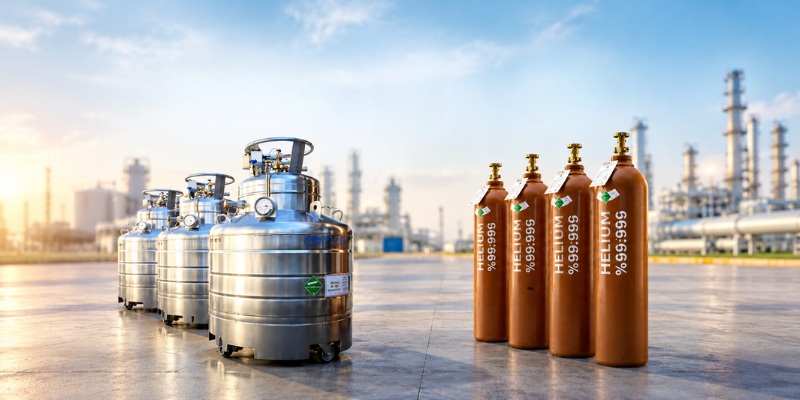
Cryogenic Dewars
Dewars are vacuum-insulated vessels designed to store and transport cryogenic liquids.
They are suitable for customers requiring liquid helium in controlled quantities for applications such as medical equipment, laboratories and research facilities.
Brothers Gas lists liquid helium Dewars in 250 L and 400 L capacities on its helium product page.
Bulk Liquid Supply
Larger users may require higher-volume cryogenic supply arrangements.
The appropriate supply method depends on:
- Consumption rate
- Storage capacity
- Delivery frequency
- Equipment requirements
- Location
- Required purity
- Operational continuity requirements
Brothers Gas provides multiple industrial-gas supply options, including Dewars, ISO containers and bulk supply solutions.
ISO Tank Supply
ISO tanks can be used for the transportation of cryogenic liquids over longer distances and between different locations.
They are particularly relevant to larger-volume or international supply chains.
Brothers Gas states that it operates an ISO tank fleet and provides international gas logistics and supply solutions.
Liquid Helium Trans-Fill Services
A reliable trans-fill operation can be an important part of the liquid helium supply chain.
Brothers Gas has established a liquid helium trans-fill facility in the UAE, supporting the transfer and supply of liquid helium for customers requiring specialized cryogenic solutions.
Its product information also states that the facility is capable of handling liquid helium ISO tanks and supporting filling into liquid helium Dewars and other supply formats.
For businesses operating critical cryogenic equipment, access to an experienced supplier and suitable trans-fill infrastructure can help support supply continuity.
What to Consider When Choosing a Liquid Helium Supplier
Choosing a liquid helium supplier requires more than comparing the product price.
For B2B customers, the supplier’s ability to support quality, logistics, cryogenic handling and continuity of supply should also be considered.
1. Product Purity
Confirm the helium purity grade and applicable impurity specifications required for your equipment or process.
2. Supply Format
Determine whether your operation requires:
- Liquid helium Dewars
- Bulk liquid helium
- ISO tank supply
- Other specialized cryogenic solutions
The appropriate format depends on consumption and equipment requirements.
3. Delivery Reliability
For critical medical, research or industrial applications, delays in cryogenic gas delivery can affect operations.
Ask the supplier about:
- Delivery schedules
- Emergency supply
- Replenishment procedures
- Local logistics
- Backup supply arrangements
4. Cryogenic Infrastructure
A supplier should have appropriate infrastructure and experience for the storage, transfer and transportation of cryogenic helium.
This can include:
- Cryogenic storage
- Insulated Dewars
- Trans-fill facilities
- ISO tanks
- Specialized transport
- Appropriate handling procedures
5. Quality Documentation
Ask for the appropriate documentation for the helium grade being supplied.
Depending on the product and agreement, documentation may include purity specifications, Certificates of Analysis and other product-quality information.
6. Technical Support
For specialized cryogenic applications, technical support can be valuable when determining:
- Suitable supply format
- Storage requirements
- Delivery frequency
- Transfer requirements
- Handling procedures
- Application-specific helium specifications
7. Safety and Handling
Liquid helium is an extremely cold cryogenic liquid. Improper handling can cause serious cold-contact injuries, and helium can also displace oxygen in confined spaces.
Appropriate ventilation, personal protective equipment, cryogenic handling procedures and oxygen monitoring where required should be considered as part of a safe operating environment.
Customers should always follow the supplier’s Safety Data Sheet (SDS), equipment manufacturer’s instructions and applicable local safety requirements.
Liquid Helium for Healthcare and Medical Applications
Healthcare is one of the most important sectors where liquid helium has traditionally been used.
MRI systems can rely on superconducting magnets that require cryogenic cooling, making helium supply an important consideration for healthcare facilities.
Brothers Gas specifically identifies healthcare among the sectors it serves and highlights liquid and gaseous helium supply for healthcare applications.
For hospitals and medical facilities, procurement teams should consider:
- Required helium specification
- MRI equipment requirements
- Dewar or supply format
- Delivery schedule
- Emergency requirements
- Technical support
- Safety and handling procedures
The exact requirements should always be confirmed with the MRI equipment manufacturer or service provider.
Liquid Helium for Research and Laboratories
Research institutions often require helium for highly specialized cryogenic and superconducting equipment.
Applications can include:
- NMR spectroscopy
- Superconducting magnets
- Cryogenic detectors
- Low-temperature physics
- Materials research
- Quantum research
- Particle physics
Research facilities may have different consumption patterns from healthcare facilities, so the supply model should be designed around the specific application and usage profile.
Liquid Helium Supply for Industrial Applications
Liquid helium also has applications beyond healthcare and research.
Depending on the industry and equipment, helium can support:
- Electronics and semiconductor manufacturing
- Aerospace applications
- Advanced scientific equipment
- Specialized manufacturing
- Cryogenic systems
- Leak detection and related processes
Helium is used across multiple sectors because of its inert properties and unique physical characteristics. Industry sources identify aerospace, electronics, healthcare and manufacturing among helium end markets.
For industrial customers, the most appropriate helium supply method depends on volume, application, purity and infrastructure.
Why Choose Brothers Gas for Liquid Helium?
Brothers Gas provides liquid and gaseous helium solutions for healthcare, industrial and specialized applications.
Its current helium offering includes:
- Liquid helium
- Gaseous helium
- Multiple helium purity grades
- Cryogenic liquid Dewars
- Liquid helium trans-fill capability
- Industrial gas supply infrastructure
- Multiple supply formats
Brothers Gas states that its liquid helium is available in 250 L and 400 L Dewars, while its helium grades range from 99.995% to 99.9999% purity.
The company also states that its UAE liquid helium trans-fill facility supports its liquid helium supply operations.
For larger industrial requirements, Brothers Gas provides additional supply options including Dewars, ISO containers and bulk delivery solutions.
Liquid Helium Supply in the UAE
For businesses in the UAE, local access to cryogenic gas infrastructure can be important for applications where supply continuity is critical.
Brothers Gas operates industrial-gas infrastructure in the UAE and provides liquid and gaseous helium solutions for local and international customers. Its industrial plant is located in Ajman, with UAE offices and facilities supporting its broader gas supply network.
Whether the requirement is for an MRI facility, research laboratory, industrial operation or specialized cryogenic application, the appropriate supply solution should be determined based on consumption, purity, storage capacity and equipment requirements.
Looking for liquid helium supply in the UAE? Contact Brothers Gas to discuss your application, required purity, quantity and preferred supply format.
Conclusion
Liquid helium is a critical cryogenic resource for applications that require temperatures close to absolute zero. Its unique properties make it particularly valuable for superconducting magnets, MRI systems, NMR equipment, cryogenic research, particle accelerators and advanced scientific instruments.
For B2B customers, sourcing liquid helium requires careful consideration of more than price. Purity, supply format, cryogenic infrastructure, delivery reliability, storage capacity, technical support and safety all contribute to a dependable helium supply strategy.
Brothers Gas provides liquid and gaseous helium, multiple purity grades, cryogenic Dewars and liquid helium trans-fill capability in the UAE, supporting customers across healthcare, research and industrial applications.
If your organization requires liquid helium for MRI, NMR, superconducting magnets, cryogenic research or another specialized application, contact Brothers Gas to discuss your quantity, purity and supply requirements.